
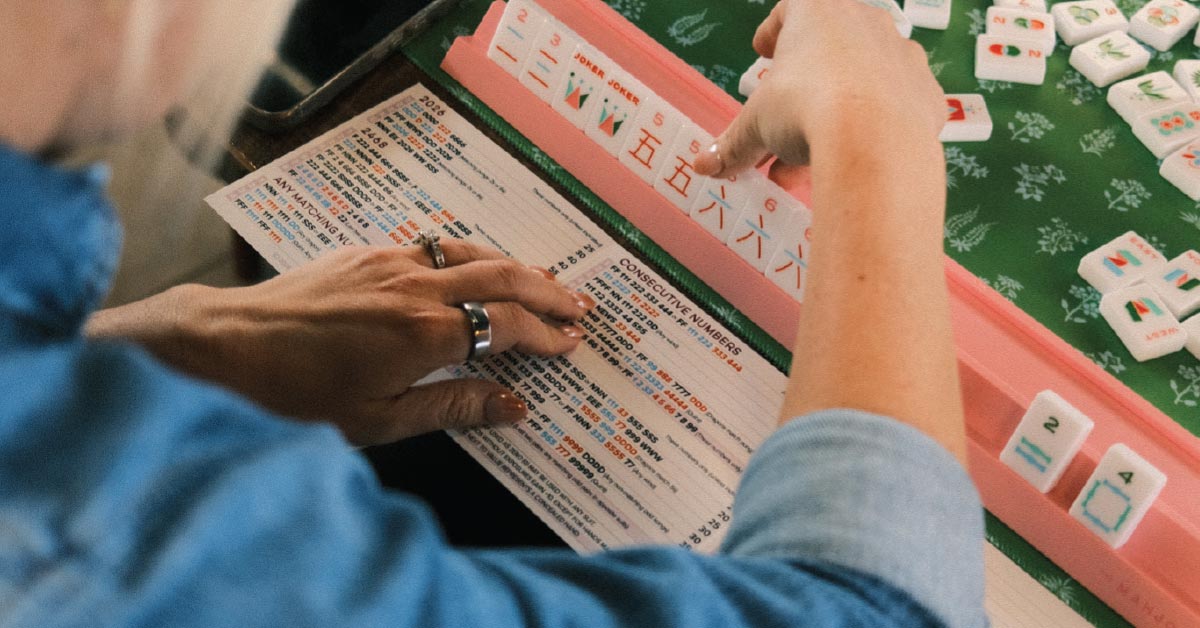
What on the surface may appear as simply an enjoyable game is truly so much more when it comes to keeping your mind sharp as you age. A cultural tradition dating back centuries, Mahjong is a Chinese tile-based game blending together skill, strategy, and luck. And more and more people are choosing to learn how to play different variants of the game, enjoying the process and the community it builds along the way.
And experts agree: It’s good for your brain!
One study published in Frontiers in Neurology found that playing Mahjong three times a week for 12 weeks led to improved attention and memory in older adults with mild cognitive impairment.
Before diving in, it’s important to recognize Mahjong’s important cultural roots. No matter the variant of Mahjong you choose, remember that when you’re playing, you’re not simply engaging in a game; you’re honoring a tradition with a rich history that deserves to be respected and properly appreciated—not appropriated.
Since October 2023, Andrea Koster and Allie Houlihan, founders of Mahj in the Mitten, have been helping players in West Michigan learn specifically American Mahjong, which was mostly forged by Jewish American women in the 1920s.
“Our teaching program is proof that the next great obsession is always just one lesson away,” Koster and Houlihan said. “In less than two years, we've brought more than 1,800 players into the fold, proving that the best communities, like the best players, only get better with age.”
The pair credit a perfect storm of culture and craving—especially as a counter to the pandemic’s prolonged periods of isolation—as a reason for the game’s increased popularity.
“After years of screens and isolation, people are hungry for real, in-person connection—and American Mahjong delivers exactly that,” they said. “Like a book club or wine night, but more engaging, it brings people together around a table filled with conversation, laughter, and a shared experience that feels genuinely good for the soul and the brain.”
While a misconception exists that the game is too hard to learn, Koster and Houlihan enjoy proving that misconception wrong and get folks playing by the end of their first lesson. The learning curve is real, of course, but that’s part of what makes it a mentally stimulating activity.
“Mahjong is built for the long haul,” they said. “The strategy and mental gymnastics required to play keep your brain sharp and agile—no matter your age. Beyond the mind benefits, there's the table itself: real, face-to-face connection that cuts through screen time and nurtures the kind of social bonds proven to support mental longevity.”
Mahjong has a way of keeping you young, the pair said, and serves as a reminder not to take yourself too seriously.
“[At our events and classes], players range from their 20s to their 80s, and some of the best moments happen when generations collide—grandparents and grandchildren going head-to-head over tiles,” Koster and Houlihan said. “Mahjong doesn't care about your age or gender; it just wants players. The eagerness in the room is real, and honestly? It's contagious.”
Ultimately, the game is just plain fun.
“No matter your age, experience level, or who you bring along, we hope you find yourself around a Mahjong table soon … The tiles are waiting.”
Follow along on Instagram and Facebook (@MahjintheMitten), visit MahjintheMitten.com for the full scoop, or reach out to the pair directly at [email protected].
Written by Sarah Suydam, Managing Editor for West Michigan Woman.
This article originally appeared in the Summer ’26 issue of West Michigan Woman.