
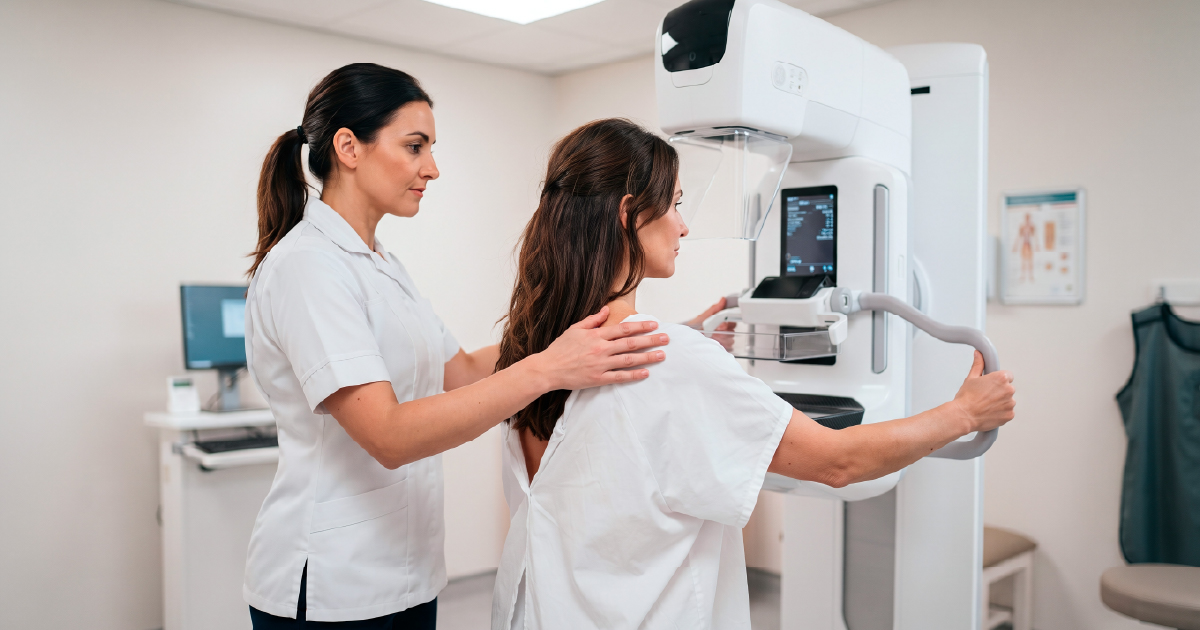
A necessary part of breast health and overall wellness, mammograms can be intimidating if you’ve never gotten one before—or if it’s been a while since you’ve had one done. For a look at common things women wish they knew before their first mammogram, we connected with Corewell Health’s Natasha Peoples, FNP-C, MSCP.
In her work as Corewell Health West APP Lead, Gynecology Division, and with the Women’s Health & Wellness Center – Midlife, Menopause & Sexual Health Services, Peoples knows a thing or two about mammograms. She explained the most current guidance on when women should ideally seek out their first mammogram.
“Major U.S. organizations agree that screening should begin around age 40, but they differ on how often to repeat it,” People said.
American Cancer Society recommends that women ages 40 to 44 should have the choice to start annual breast cancer screening with mammograms if they wish to do so, while women age 45 to 54 should get mammograms every year. ACS also says that women 55 and older should switch to mammograms every two years, or can continue yearly screening. Women who are at a higher risk of breast cancer (a greater than 20% lifetime risk) from factors such as having the BRCA mutation, a first-degree relative with breast cancer, and/or prior chest radiation, should begin screening sooner—often age 30, or 10 years before the youngest affected relative’s diagnosis, and may choose to add a breast MRI to their preventative care.
Do I have to do anything to prepare for my first mammogram?
Some women may be wondering if there’s anything they should do to be prepared for their first mammogram. According to Peoples, the good news is that there is nothing you have to do to prepare.
“A few simple choices can make the experience easier: if you are still menstruating, consider scheduling for a time when your breasts are usually least tender—often the week after your period,” Peoples recommended. “On the day of the exam, skip deodorant, antiperspirant, powders, and lotions on your chest or underarms because they can create artifacts on the images. Wear a two-piece outfit so you only need to undress from the waist up, and bring prior mammogram images or arrange to have them transferred; having those comparisons can reduce callbacks. If you are lactating, breastfeeding or pumping just before the exam may improve comfort and image quality.”
What does the mammogram process look like and does it hurt?
Peoples explains that a mammogram is a quick outpatient X-ray, and that knowing what will happen can make it feel much less intimidating.
“A technologist positions one breast at a time on a platform and briefly compresses it with a paddle while the images are taken,” she said. “The entire appointment usually takes about 15–20 minutes. The compression lasts only seconds for each view. Most women describe pressure or brief discomfort rather than lasting pain, although everyone’s sensitivity is different. If your breasts are often tender, you may choose to take an over-the-counter pain medication such as ibuprofen or acetaminophen before the appointment.”
How does the mammogram process differ for women with breast implants?
“Women with breast implants can and should still undergo routine screening mammography,” Peoples emphasized. “The key difference is technique: extra ‘implant-displacement’ views are added, in which the implant is pushed back so more breast tissue can be imaged. This means more images than a standard mammogram. Facilities should ask about implants in advance and refer elsewhere if they don’t image implant patients. Note that mammography is for cancer screening—it is not the test used to evaluate a suspected implant rupture (MRI is preferred for that).”
Is it common for women to be nervous or scared ahead of their first mammogram?
“It is very common to feel nervous before a first mammogram, especially when you do not know exactly what to expect,” Peoples said. “Anxiety and breast-cancer–specific worry are well documented and are recognized among the most common downsides of screening. I remind patients that asking questions and telling the technologist that it is their first mammogram can help the experience feel more manageable.”
What are some factors that could potentially be the cause of stress ahead of a mammogram?
“Fear of a cancer diagnosis; anticipation of pain from compression; uncertainty about the process itself; and worry about being called back,” Peoples shared. “False-positive callbacks are a major contributor and are associated with measurably increased anxiety and even higher rates of antidepressant/anxiolytic prescriptions, particularly when women wait more than a week for results or undergo a biopsy.”
Is it normal for a mammogram to return results that need further insight but then turn out to be nothing concerning?
“Yes—this happens often, especially after a first mammogram, and a callback does not automatically mean cancer. Roughly 10–12% of mammograms in women ages 40–49 are false positives, and callbacks are more common with a first mammogram,” Peoples explained. “Over a decade of screening, 50–60% of women will have at least one false-positive recall, yet only a small fraction turn out to have cancer. Prior images can lower the chance of a callback because the radiologist has something to compare. I often tell patients, ‘The first mammogram gives us your baseline. If we see a spot, we may simply need more images because we do not yet know whether it has always been there.’”
What are some questions you recommend women ask their providers to ease their minds?
Peoples offered up the following questions for women to ask:
- What is my personal breast cancer risk? Does it change when I should start or how often I should screen?
- Do I have dense breasts? Would supplemental imaging (ultrasound or MRI) be appropriate?
- How and when will I get my results? Who do I call with questions?
- If I’m called back, what does that mean and what happens next?
What else should women know about mammograms before getting their first one done?
The most important thing Peoples wants women to know is that mammography can detect breast cancer earlier, when treatment is often most successful.
“Breast cancer caught early is treatable and curable approximately 95% of the time. Like any screening test, mammography has trade-offs, including false positives, additional imaging or biopsy, and overdiagnosis—finding cancers that would never have caused harm,” Peoples said. “Dense breast tissue can make mammograms harder to read and is also an independent breast cancer risk factor. Since September 2024, a federal FDA rule has required mammography facilities to tell women if they have dense breast tissue.”
This is common, according to Peoples, with roughly 40% to 50% of women of screening age having dense breasts, so the finding is not abnormal by itself.
“Some women worry about radiation, but the dose from a mammogram is very low, similar to the natural background radiation a person receives over about seven weeks,” Peoples explained, adding that having a mammogram does not replace knowing what is normal for your own breasts. “A new lump, skin or nipple change, or discharge should always be evaluated, even after a recent normal mammogram.”
Peoples’ best advice is simple: Don’t let uncertainty keep you from the conversation.
“Ask your healthcare provider when screening should begin for you and how often it should be repeated,” she said, noting that decision should be individualized and shared. “If you have a strong family history, a known genetic mutation in your family, or a prior abnormal mammogram or biopsy, ask whether a breast specialist should help guide your screening plan. Your first mammogram may feel like a big step—but it is also a powerful way to take care of your future health.”
Written by Sarah Suydam, Managing Editor for West Michigan Woman.