
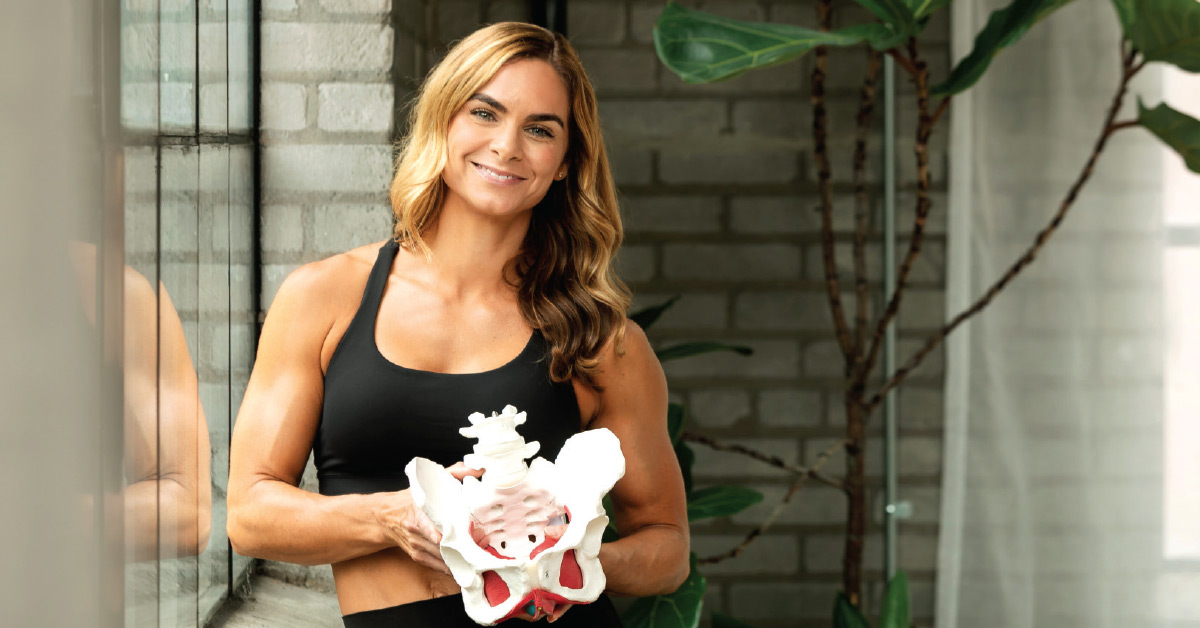
Dr. Caroline Packard, DPT, is a pelvic floor physical therapist, certified yoga instructor, lifelong athlete, and mother of three who is changing the way women think about their bodies, strength, and what’s possible after pelvic floor dysfunction. She’s the founder of Connect Pelvic Floor Fitness, a popular comprehensive training platform that treats the pelvic floor as the foundation of total-body strength. Drawing from over 15 years of clinical expertise and her own lived experience, Dr. Packard brings a clear, practical voice to women’s pelvic health, fitness, and movement.
How did your own experience with pelvic floor dysfunction influence the creation of your own program?
I built Connect because I needed it.
After my pregnancies, I was dealing with prolapse and leaking, and the path back to the workouts I loved was confusing and isolating. The fixes offered were surface level: have surgery or give up the things I loved. Here’s what stopped me: I’m a physical therapist, and even I couldn’t find an approach that got me back to real training. If it was that hard for me, imagine it for women without my background.
So, I built the program I wished existed, one that treats the pelvic floor as the foundation of total-body strength, combining advanced pelvic floor rehab with strength training, yoga, and breathwork. It worked for me, and it’s since reached more than 100,000 women.
Why does pelvic floor health require a whole-body approach?
Because the pelvic floor never works in isolation. It’s a foundational part of your core that relies on your hips, spine, and diaphragm. So, when something feels off, the real cause is usually the whole system, not the pelvic floor alone.
A holistic approach ensures those underlying restrictions get resolved instead of just masking the symptom. This is the gap Connect was built to fill. Many women step back from workouts they love because of leaking, pressure, or pain. Traditional fitness rarely accounts for the pelvic floor, and rehab often stops short of rebuilding full-body strength.
Connect teaches women to train with the pelvic floor—not against it. It moves through progressive phases, starting with a personalized assessment, then layering in education, full-body strength, and mobility with pelvic floor mechanics in every workout. That’s what makes it different from a standard fitness app or a few rounds of PT.
What are some pelvic floor dysfunction symptoms that have become normalized?
Leaking is the obvious one, but it goes much further: urgency, heaviness, pelvic pressure, pain with sex, a disconnected core, even low back and hip pain or feeling unstable when you move. For active women, they show up when demand increases: running, jumping, lifting, carrying kids.
Women are told this is just part of having babies or getting older, so they quietly accept it. But common is not the same as normal.
I want women to understand the symptom is only the entry point. The real story is how your whole system manages pressure and load. So many women arrive thinking they’re broken or unsafe to move, when their body is just asking for a better strategy. My mission is to help women address the root causes of their symptoms and return to the things they love. I want every woman to know she isn’t broken. There’s a path forward, and you can live without limits.
Edited by Sarah Suydam, Managing Editor for West Michigan Woman.
This article originally appeared in the Fall ’26 issue of West Michigan Woman.
Photo courtesy of Connect Pelvic Floor Fitness.